

Designing a landing page that connects and converts
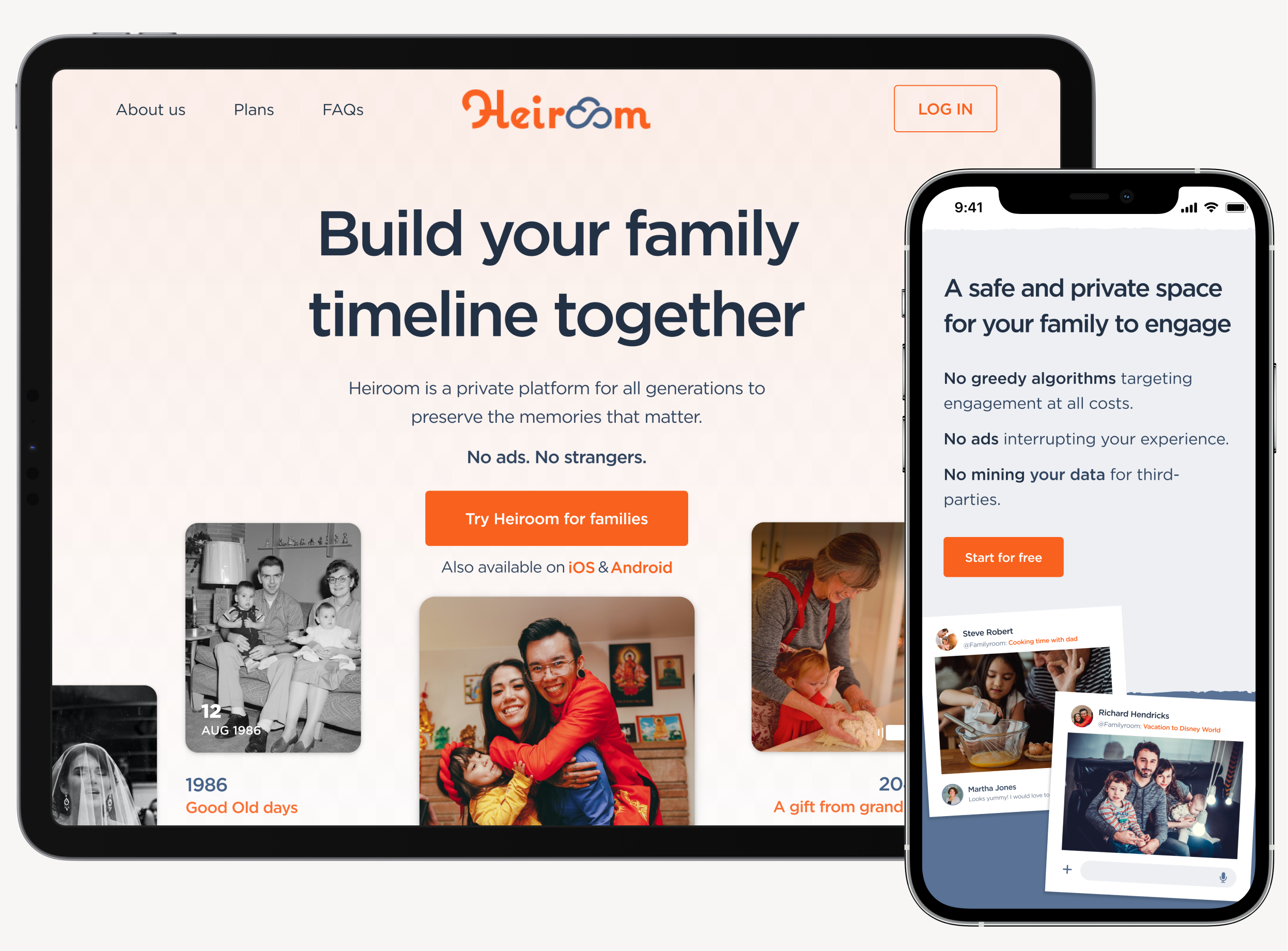
Heiroom is a family-focused social platform aimed at fostering safe, engaging digital experiences. Our challenge was that the initial landing page failed to communicate the platform’s value clearly, leaving users uncertain about subscriptions and interactive features. I led a research-driven redesign, synthesizing qualitative insights, competitive analysis, and iterative user testing to refine messaging, clarify subscription tiers, and showcase the platform’s interactive storytelling.
Challenge - Heiroom’s original landing page, which experienced a poor conversion rate of less than 2%, failed to clearly communicate its family-focused value, leaving users confused about subscription tiers and platform purpose. The challenge was to craft a concise, credible, and engaging experience that immediately conveyed trust, clarity and differentiation, driving both understanding and adoption.


I began by aligning with stakeholders on Heiroom’s long-term vision and commercial intent, then translated that into a clear value proposition for the landing page. From there, I conducted a comparative analysis across both direct and indirect competitors—from family-focused social platforms to storage, storytelling, and activity-based products—to understand where Heiroom truly differentiated. This surfaced a critical insight: while many products owned features, none owned family continuity over time. To ensure the landing page reflected what actually mattered to users (not just what the product could do).
I paired this analysis with KANO-based feature prioritisation, narrowing the surface area to only those capabilities that delivered immediate user value and trust. This research informed an initial hypothesis-led design that emphasised family-first positioning, storage-based pricing clarity, and visual previews of core functionality.


We validated this direction through moderated user testing across key audience segments, using the initial landing page as a testable hypothesis rather than a final solution. Testing revealed three consistent breakdowns: “non-toxic social media” messaging triggered negative associations rather than reassurance, storage-based pricing created confusion around whether plans were per-user or per-family, and static screenshots led some users—particularly older audiences—to misinterpret Heiroom as a storage tool rather than an interactive platform. In response, I iterated the experience as a single cohesive refinement: reframing the narrative around a shared family timeline, clarifying plans as “one room for the whole family,” and introducing lightweight motion to demonstrate interaction and emotional value. This unified iteration shifted perception from utility to connection, directly addressing the trust and clarity gaps surfaced in research.

Through three iterations of testing and design, we successfully finalized the landing page that clearly highlights the values families would benefit from Heiroom.
Shifted messaging away from “non-toxic social media” toward a family timeline and shared storybook, reducing negative associations and helping users immediately understand Heiroom as a place to connect, not just store content.
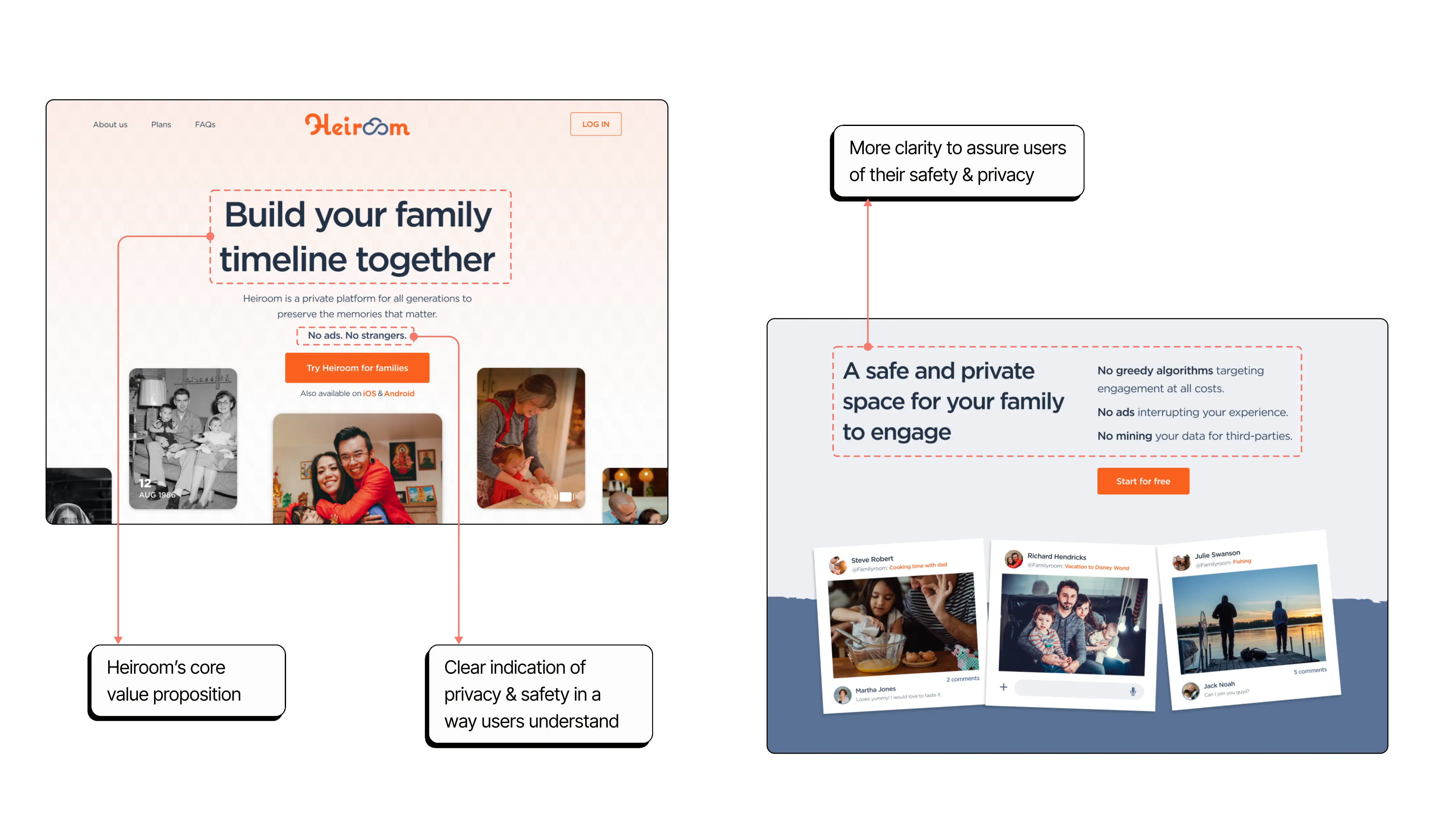
Collapsed storage- and user-based tiers into a single family plan, addressing confusion around ownership and eligibility while reinforcing the idea of one shared space for the entire family.
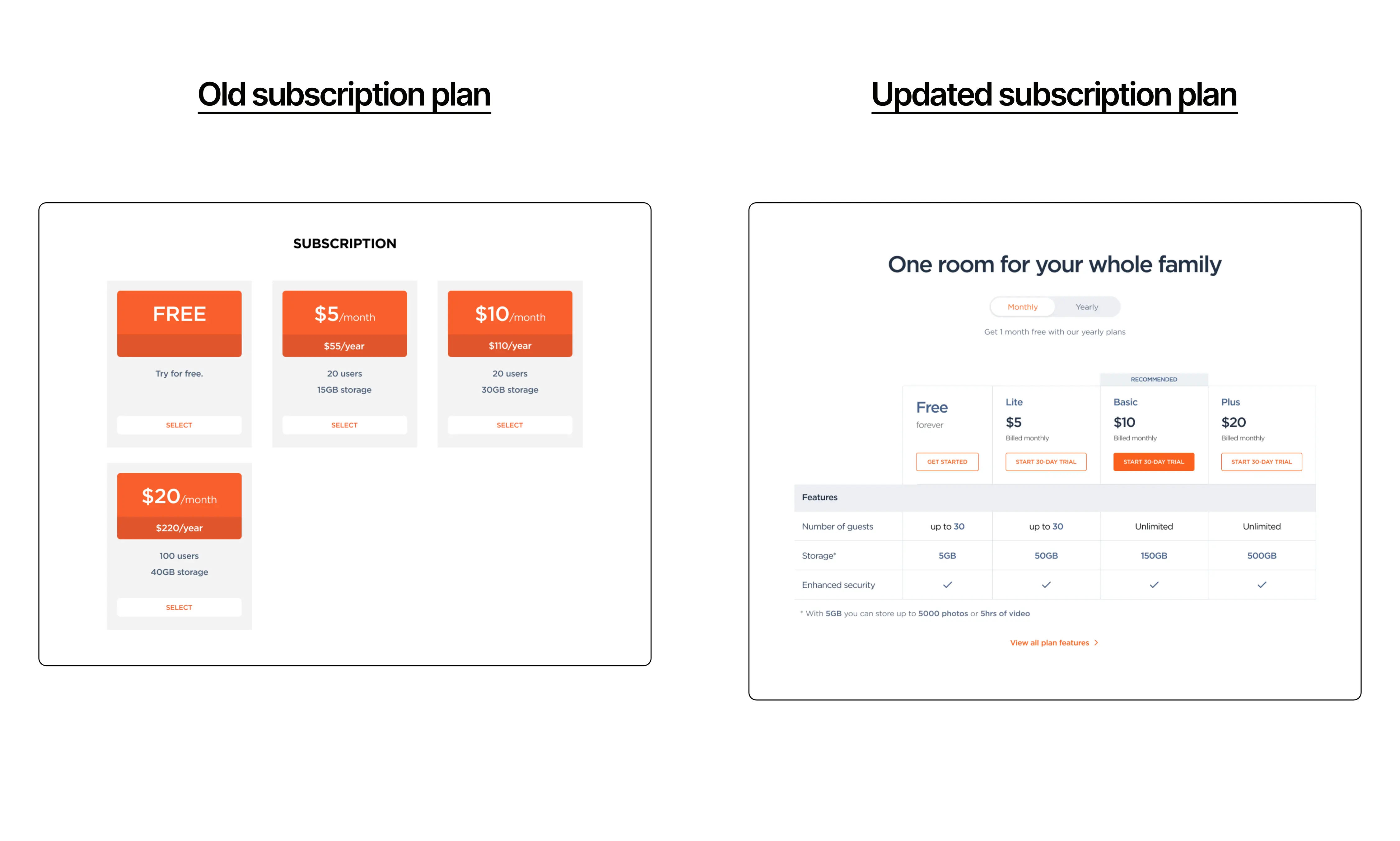
Replaced static screenshots with lightweight GIFs to demonstrate commenting, reacting, and shared storytelling, correcting the perception that Heiroom was passive storage rather than an interactive social product.
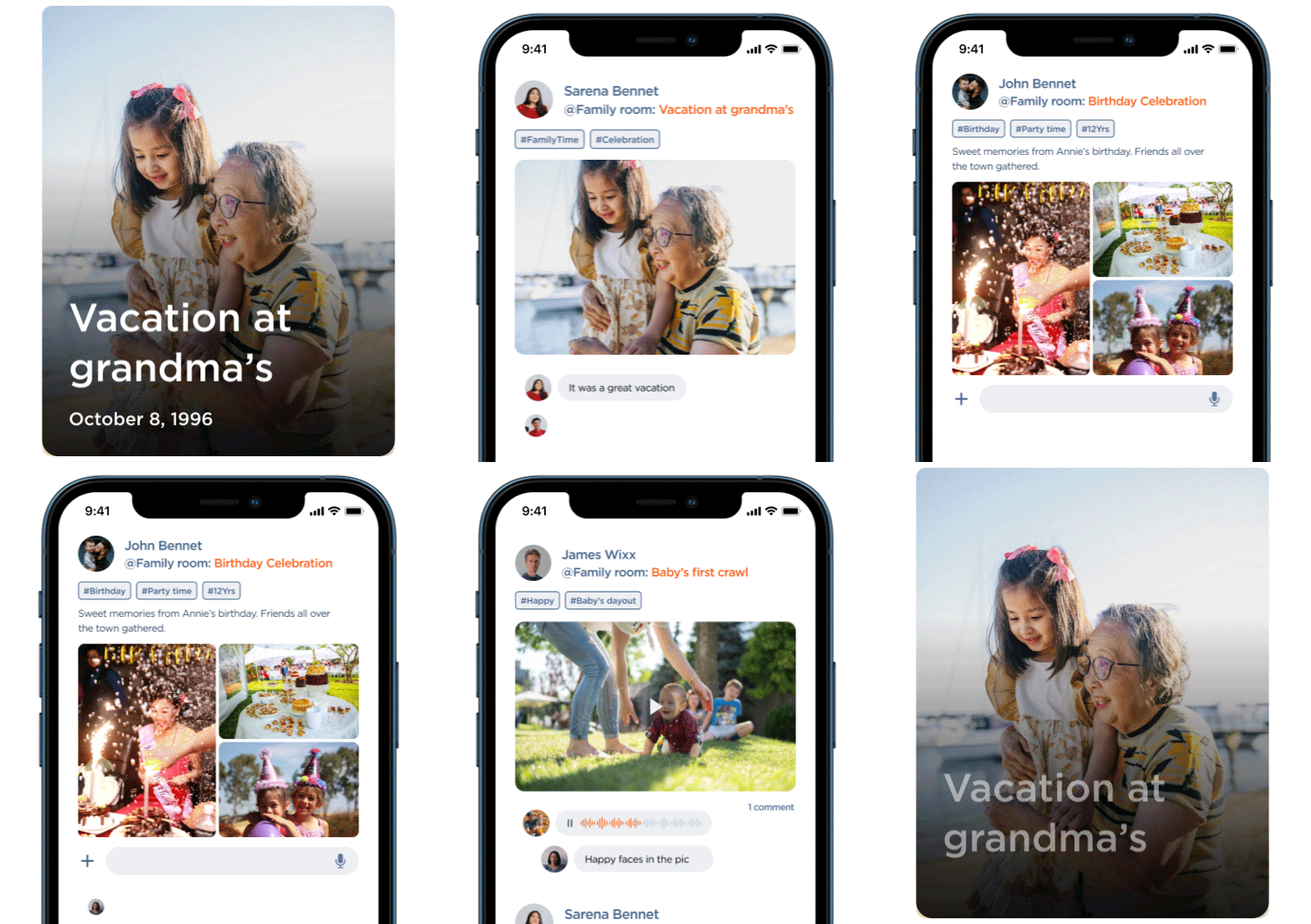
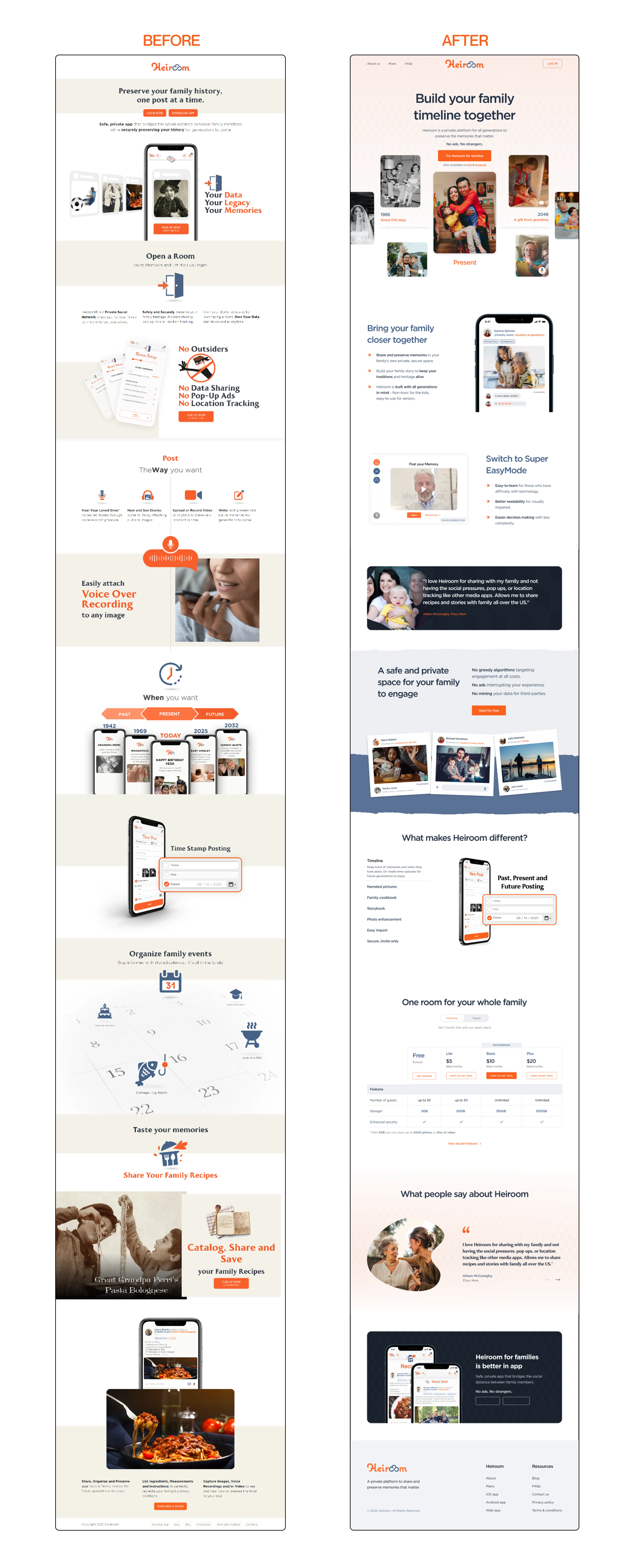
Signup conversion increased from <2% to 12% with 6× improvement from where it was
Users correctly identified Heiroom as a social platform for families, up from 34% before the redesign.
32% of users converted to a paid plan, exceeding the 20% target and validating pricing clarity and value framing.
Average time to select a plan reduced from 3.4 minutes to 45 seconds, indicating significantly lower decision friction.

This work reinforced the importance of validating assumptions early with real users, as initial positioning created unintended confusion despite strong intentions. Iterative testing, paired with disciplined prioritization, allowed the team to focus on what actually moved understanding and confidence rather than layering on features or messaging. Most importantly, the project demonstrated that clarity is a design outcome in itself—when users clearly understand a product’s purpose, both engagement and business performance follow.


